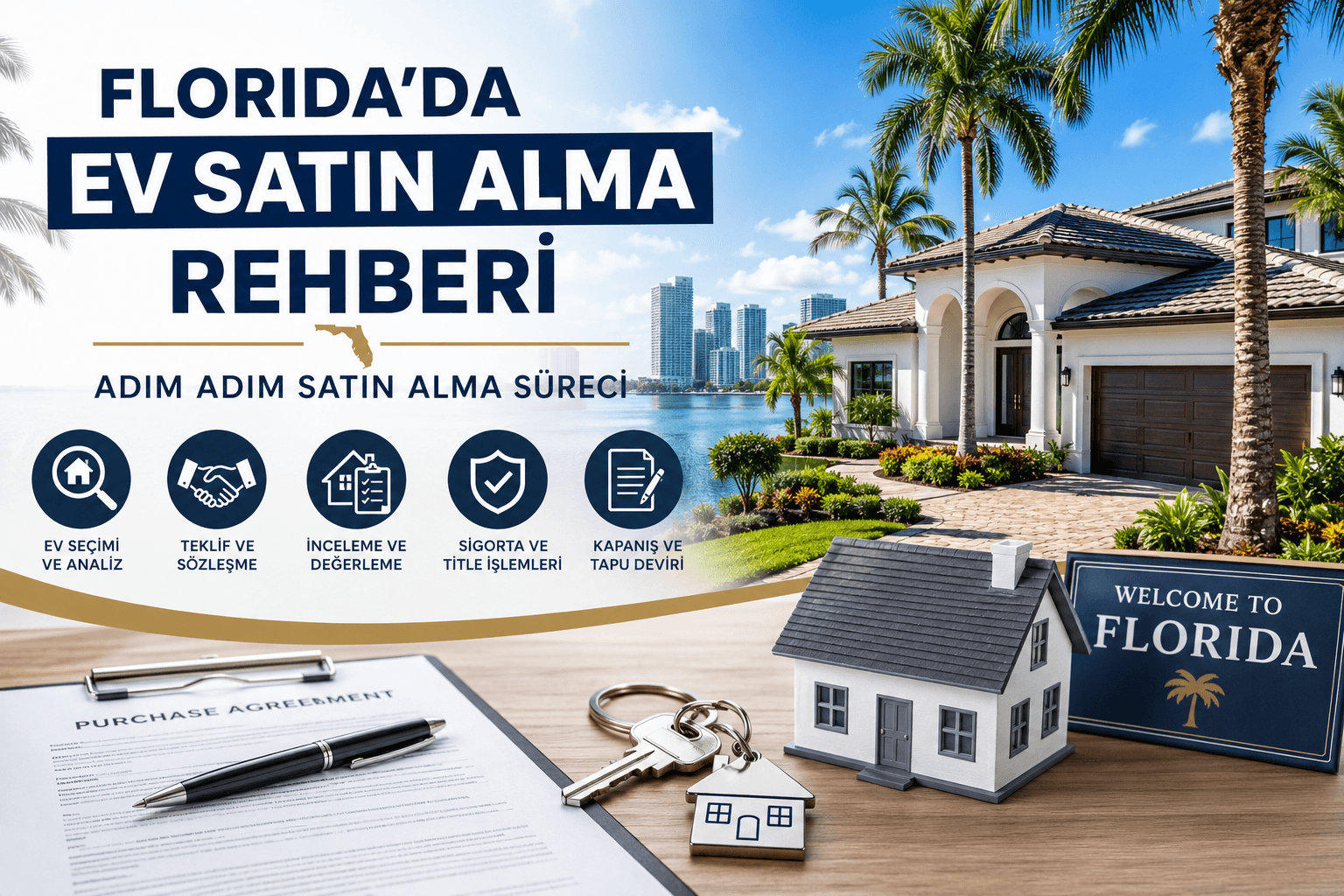
Florida Home Buying Guide: The Purchase Process Step by Step
Florida Home Buying Guide: The Purchase Process Step by Step
Florida is one of the most popular states in the United States for people looking to purchase a home, thanks to its warm climate, beaches, growing cities and wide range of real estate options.
Cities such as Miami, Orlando, Tampa, Jacksonville and Fort Lauderdale each offer different lifestyle and investment opportunities. However, buying a home in Florida involves much more than finding a suitable listing and paying the asking price.
Budget planning, financing, making an offer, property inspections, appraisal, insurance, title review, HOA documents and closing procedures must all be evaluated together.
This guide explains the Florida home-buying process step by step.
1. Define the Purpose of Your Purchase
Before beginning your property search, clearly determine why you want to buy the home.
A Florida property may be purchased for:
- Permanent residence
- Vacation-home use
- Long-term rental income
- Short-term vacation rental
- Family use or children’s education
- Long-term appreciation
- Holding a United States dollar-denominated asset
Your purchase objective directly affects the city, neighborhood, property type and budget you should consider.
For example, an investor targeting long-term family tenants may consider areas such as Jacksonville or Doral, while a buyer interested in vacation rentals may focus on approved resort communities around Orlando.
2. Calculate Your Total Budget
The listing price does not represent the total cost of purchasing a property.
Your budget may also need to include:
- Down payment
- Mortgage origination expenses
- Appraisal fee
- Home inspection
- Title search
- Title insurance
- Closing or escrow services
- County recording fees
- Insurance premiums
- Property-tax adjustments
- HOA application and transfer fees
- Furniture and renovation costs
Florida imposes documentary stamp tax on deeds transferring real estate ownership. In counties outside Miami-Dade, the general rate is $0.70 for every $100, or portion of $100, of consideration. Miami-Dade County generally applies a base rate of $0.60, with an additional surtax applying to certain transactions.
It is more accurate to plan your budget according to the total first-year ownership cost rather than only the amount due on the purchase date.
3. Compare Cash and Mortgage Options
A Florida property can be purchased with cash or mortgage financing.
Buyers planning to use a mortgage should research financing options before beginning their property search.
A lender may evaluate:
- Income and assets
- Credit history
- Existing debt
- Down-payment amount
- Source of funds
- Appraised property value
- Insurance and property-tax costs
Foreign-national mortgage programs may be available to people living outside the United States. However, these loans may require a larger down payment, bank statements, income documentation and proof of additional financial reserves.
When comparing mortgage offers, consider more than the interest rate. Review the annual borrowing cost, origination fees, prepayment penalties and total amount due at closing.
4. Select the Right City and Neighborhood
Florida cities can cover large geographic areas. Two neighborhoods within the same city may differ significantly in price, quality of life, safety, tenant demand and insurance costs.
When selecting a location, consider:
- Proximity to employment centers
- Schools and universities
- Hospitals
- Airports
- Main roads and public transportation
- Distance from the coast
- Shopping and entertainment
- Planned infrastructure projects
- Local housing inventory
- Current rental and sale prices
When purchasing for investment purposes, do not rely only on estimated rental figures shown in property listings.
Research comparable homes that have actually been rented and determine how long similar properties typically remain vacant.
5. Work With a Real Estate Professional
A licensed Florida real estate professional can help you access listings and manage the purchase process.
A real estate professional may assist with:
- Neighborhood and market analysis
- Comparing recent sales
- Preparing an offer
- Negotiating with the seller
- Coordinating the inspection process
- Obtaining HOA documents
- Communicating with title and closing providers
Ask for written clarification regarding whom the agent represents and how the commission will be paid.
For investment purchases, consider working with someone who understands rental markets, HOA restrictions and property operating expenses rather than someone focused only on residential sales.
6. Make an Offer
Once you identify a suitable property, a written offer is submitted to the seller.
The offer commonly includes:
- Purchase price
- Earnest-money deposit
- Financing contingency
- Inspection period
- Appraisal contingency
- Closing date
- Requested seller contributions
- Furniture and equipment included in the sale
- Allocation of title and closing expenses
The seller may accept, reject or counter the offer.
Once both parties agree and sign the contract, the transaction becomes legally binding. Cancellation rights, deadlines and deposit conditions should therefore be reviewed carefully.
Protective contingencies can help the buyer withdraw from the transaction when financing, inspection, appraisal or title problems arise.
7. Deposit the Earnest Money Into Escrow
After the purchase contract is signed, the buyer generally deposits an earnest-money amount as a sign of good faith.
This money is usually not paid directly to the seller. It is held in an escrow account managed by a title company, escrow agent, attorney or another authorized party.
At closing, the deposit is credited toward the purchase price or the buyer’s closing expenses.
Whether the deposit is refunded after cancellation depends on the contract terms. Missing inspection, financing or appraisal deadlines may cause the buyer to lose the deposit.
8. Arrange a Professional Home Inspection
A home inspection evaluates the property’s physical condition.
The inspector commonly reviews:
- Roof
- Air-conditioning system
- Electrical installation
- Plumbing
- Foundation and structural components
- Doors and windows
- Moisture and mold indicators
- Swimming pool
- Appliances
- Water heater
- Exterior condition
Older Florida homes may also require a four-point inspection and wind-mitigation inspection.
A four-point inspection generally focuses on the roof, electrical system, plumbing and air-conditioning system. A wind-mitigation inspection evaluates features that may protect the home against strong winds and storm damage.
A home inspection and an appraisal serve different purposes. The inspection focuses on physical condition, while the appraisal focuses on market value.
Mortgage-financed purchases often involve both.
9. Review the Appraisal Result
In mortgage-financed transactions, the lender generally orders an independent appraisal.
The purpose of the appraisal is to determine whether the property’s market value supports the purchase price and loan amount.
When the appraised value is lower than the purchase price:
- The price may be renegotiated
- The buyer may pay the difference in cash
- The appraisal may be challenged
- The buyer may consider cancelling under an appraisal contingency
A low appraisal can directly affect the amount the lender is willing to finance.
10. Obtain a Title Search
In United States real estate transactions, “title” refers to legal ownership rights. A “deed” is the official document used to transfer those rights from the seller to the buyer.
A title search reviews the property’s historical records.
The search may reveal:
- Unpaid property taxes
- Existing mortgages
- Court judgments
- Contractor liens
- Historical recording errors
- Ownership claims
- Easements
- Use restrictions
Title services may include the ownership search, title insurance policies and, in many areas, the services of the professional managing the closing.
Buyers may be able to compare prices from different title and closing providers.
11. Consider Owner’s Title Insurance
A mortgage lender generally requires lender’s title insurance. However, this policy protects the lender’s financial interest.
Owner’s title insurance is designed to protect the buyer’s ownership rights and invested capital.
After closing, a historical recording error, unpaid obligation or third-party ownership claim could emerge.
Owner’s title insurance is not federally required in every transaction, but it can provide important protection, particularly for international investors and properties with complicated ownership histories.
12. Confirm Insurance Costs Before Finalizing the Purchase
Insurance is one of the expenses that can have the greatest effect on the total cost of owning property in Florida.
Premiums may vary according to:
- Year of construction
- Roof age
- Distance from the coast
- Flood-zone classification
- Building materials
- Wind protection
- Condition of the electrical and plumbing systems
- Previous damage or claims
- Personal or rental use
Instead of relying on general internet averages, obtain a written quotation for the specific property you plan to purchase.
A home that is difficult or expensive to insure may not be a good investment even when the purchase price appears attractive.
13. Review Flood Risk
The official flood map should always be reviewed before purchasing property in Florida.
The FEMA Flood Map Service Center provides public flood-hazard information prepared under the National Flood Insurance Program.
However, a property located outside an officially designated high-risk flood zone may still face flood exposure.
Also investigate:
- Previous neighborhood flooding
- Drainage conditions
- Property elevation
- Prior insurance claims
- Proximity to waterways or the coast
- Cost of optional flood coverage
14. Review HOA and Condominium Documents
When purchasing a home within a planned community or condominium building, examine the HOA documents carefully.
Request:
- Declaration
- Bylaws
- Rules and regulations
- Current budget
- Reserve-fund information
- Recent meeting minutes
- Building insurance
- Pending litigation
- Planned fee increases
- Special-assessment decisions
HOA rules may restrict:
- Long-term leasing
- Airbnb and short-term rentals
- Pets
- Parking
- Renovations
- Business use
- Guests
- Vehicle types
Even when the unit itself is in excellent condition, insufficient reserves or a major upcoming assessment can significantly increase the total investment cost.
15. Recalculate the Property Tax
Florida property taxes vary by county and local jurisdiction.
The seller’s current tax bill may not accurately represent the amount the new owner will pay. After a sale, the taxable value of the property may be reassessed.
Review historical records through the county property appraiser and estimate the post-purchase property tax.
Eligible owners who use the property as their permanent primary residence may qualify for a homestead exemption, which can reduce the taxable value by up to $50,000.
Applications are submitted to the property appraiser in the county where the home is located.
Vacation homes, second homes and investment properties generally do not receive the same homestead benefits.
16. Officially Confirm Rental Rules
When buying for investment purposes, confirm that the intended rental model is legally permitted.
For long-term rentals, an HOA may impose restrictions such as:
- Prohibition on renting during the first year of ownership
- Minimum lease duration
- Limits on the number of leases per year
- Tenant-approval requirements
- Application and registration fees
- Prohibition on corporate leasing
Short-term rentals require a review of municipal, county, HOA and state regulations.
New vacation-rental operators and new owners taking over an existing rental operation may need to obtain the appropriate Florida license before beginning business.
A property listing stating “Airbnb allowed” does not constitute official legal approval.
17. Select the Ownership Structure Before Closing
Before closing, determine whose name or which legal entity will appear on the deed.
Possible ownership structures include:
- Individual ownership
- Joint ownership between spouses
- Ownership by multiple investors
- LLC ownership
- Trust ownership
The selected structure may affect financing, taxation, legal liability, estate planning and the future sale.
International investors should not rely solely on a real estate agent’s recommendation. Transaction-specific tax and legal advice should be obtained from qualified United States professionals.
18. Review the Closing Disclosure
In many mortgage-financed residential purchases, the lender must provide the Closing Disclosure at least three business days before closing.
The document includes:
- Loan amount
- Interest rate
- Monthly payment
- Closing costs
- Taxes
- Insurance expenses
- Total amount due at closing
Compare the Closing Disclosure with the earlier Loan Estimate.
Ask for clarification before signing when unexpected fees or changed loan terms appear.
In cash purchases, the standard mortgage Closing Disclosure may not apply. A settlement statement may instead be prepared to show the amounts collected and distributed during the transaction.
19. Protect Yourself Against Wire Fraud
Because large sums are transferred by bank wire during real estate closings, buyers can become targets of fraud.
Criminals may impersonate a real estate professional, title company or closing agent and send false bank instructions.
Before transferring funds:
- Verify the account information by telephone
- Call a previously confirmed official number
- Treat last-minute account changes as suspicious
- Confirm the beneficiary name and bank details
- Speak directly with the title or closing company
Buyers are often targeted shortly before closing, when they are expecting payment instructions.
20. Confirm the Deed Was Recorded
After the closing documents are signed and the funds are transferred, the deed is submitted to the recording office in the county where the property is located.
Once recorded, the ownership transfer becomes part of the public record.
After closing, retain copies of:
- Recorded deed
- Final settlement statement
- Title insurance policy
- Inspection reports
- Insurance documents
- HOA documents
- Mortgage records
- Tax and closing-payment records
Can Foreign Buyers Purchase a Home in Florida?
Foreign buyers can purchase Florida real estate in many circumstances. However, the same rules do not apply to every international buyer.
Florida law includes certain restrictions affecting defined foreign-principal categories, agricultural land, property near military installations or critical infrastructure, and some other types of real estate.
The buyer’s citizenship, residence status and the property’s location should be reviewed on a transaction-specific basis.
International buyers may be asked to provide:
- Passport
- Proof of address
- Bank statements
- Source-of-funds documentation
- Income and asset records for financing
- Company documents when purchasing through a legal entity
- ITIN or EIN when required for tax or entity purposes
Purchasing a property does not eliminate the buyer’s tax, immigration or residency obligations.
Why Is FIRPTA Important?
When a foreign owner later sells United States real estate, federal withholding may apply under FIRPTA.
The general withholding rate is 15% of the amount realized by the foreign seller.
In most transactions, the buyer is responsible for withholding and remitting the required amount to the IRS. Certain exceptions and reduced-withholding procedures may be available.
FIRPTA withholding is not necessarily the seller’s final tax liability.
The foreign seller may later file a federal tax return and receive a refund or pay additional tax based on the actual taxable gain.
International investors should therefore plan not only for the initial purchase but also for future rental income and eventual sale.
Florida Home-Buying Checklist
Before completing the transaction, review:
- Purchase objective
- Total budget
- Financing approval
- Neighborhood analysis
- Comparable sales
- Home inspection
- Four-point and wind-mitigation reports
- Appraisal
- Insurance quotations
- Flood-zone status
- Title search
- Owner’s title insurance
- Property taxes
- HOA budget and reserves
- Special assessments
- Rental permissions
- Ownership structure
- Closing Disclosure
- Wire instructions
- Deed recording
Conclusion
Buying a home in Florida may provide valuable lifestyle and investment opportunities. However, the decision should not be based only on the property’s location or purchase price.
Insurance, flood exposure, property taxes, HOA expenses, title condition, inspections and rental rules can directly affect the total investment outcome.
Defining your objective and budget at the beginning of the process, obtaining professional assistance and reviewing all documents before closing can significantly reduce avoidable risks.
Explore Florida real estate opportunities.
This article is provided for general informational purposes and does not constitute legal, tax, mortgage or investment advice. Rules and costs may vary according to the property location and transaction structure.
Salman Kurt
Executive insights, global real estate intelligence, and luxury tourism perspectives.